


The Muriel Rukeyser Living Archive
As a “Living Archive,” our website is designed to foster lively conversations about this important twentieth‑century poet. We feature a rotating selection of poems by Muriel Rukeyser. Published with permission of Bill Rukeyser, the poet’s son, these poems offer a representative glimpse into her vast and varied body of work. The Collected Poems of Muriel Rukeyser, edited by Janet Kaufman and Anne Herzog with Jan Heller Levi and published by the University of Pittsburgh Press, remains the most comprehensive edition of her poetry. Also have a look at our Rukeyser trailblazers page, honoring the first generation of Rukeyser scholars, editors, and publishers, who made sure that her life and work would not be forgotten but receive the recognition it was due.
We invite you to spend a few minutes exploring the site. And we encourage you to contribute your own responses—critical, pedagogical, or creative—by contacting us here.
Eric Keenaghan, Unburying History: Two Lost Antifascist Poems by Muriel Rukeyser
What does it mean to be antifascist? The answer seems self-obvious: to oppose fascism. But when does that opposition happen? And at what point does it become a legitimate and recognizable form of resistance? Too often, we tend to discount cultural activism, the only sort of resistance most art can produce, as inadequately political. Political poetry, antifascist poetry, stuck to the page rather than moving through the street, seems detached from oppressive realities, opting for the aesthetic over the sociopolitical. Direct actions, with their performative and theatrical dimensions, have an aesthetic quality, too. But even for those of us who love the art and believe it can transform readers, much poetry’s unapologetic links to the unseen and the private seem to interfere with its political impact. Subjective change rarely produces measurable, objective results. For resistance to fascism to be adequate, shouldn’t it require as much spectacularity as that demonstrated by the wielders of the same force and violence which we wish to challenge? Don’t we need visible, quantifiable signs of the ground we have regained by resisting fascist creep?
My own doubts about poetry’s potential antifascist force are rather recent, a product of the powerlessness I have felt since the start of Trump’s second presidential administration. Before, during, and after the first one, I had no problem calling Muriel Rukeyser radical and naming her an antifascist.
With regularity, though, my students even then refused to recognize her through those labels. “She’s too private, she doesn’t disclose her full position in society. You’ve written about that yourself,” they charged. “How can someone who withholds her personal truth create social transformation in the name of truth?” Or they complained, “She’s too private, a lyricist who never strays too far from her personhood.” I suppose they believed her insufficiently public to have been politically effective, no matter the fact that publishing literary work with a clear resistant vision is, at its core, a public act.
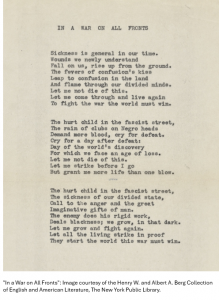
In a War on All Fronts (1943)
Sickness is general in our time.
Wounds we newly understand
Fall on us, rise up from the ground.
The fevers of confusion’s kiss
Leap to confusion in the land
And flame through our divided minds.
Let me not die of this.
Let me come through and live again
To fight the war the world must win.
The hurt child in the fascist street,
The rain of clubs on Negro heads
Demand more blood, cry for defeat.
Cry for a day after defeat:
Day of the world’s discovery
For which we face an age of loss.
Let me not die of this.
Let me strike before I go
But grant me more life than one blow.
The hurt child in the fascist street,
The sickness of our divided state,
Call to the anger and the great
Imaginative gifts of man.
The enemy does his rigid work,
Deals blackness; we grow, in that dark.
Let me grow and fight again.
Let all the living strike in proof
They start the world this war must win.
Rukeyser News
Archive News! Recordings of Louise Kertesz’s two conversations with Muriel Rukeyser are now available online at EMU’s Digital Commons. Transcripts of the conversations can also be downloaded. All the documents of the Louise Kertesz papers have been digitized and can be found, as well, at EMU’s Digital Commons.
Vivian Pollak‘s donation of the Arthur MacGillivray Papers to Eastern Michigan University’s Muriel Rukeyser Collection can now be explored through a finding aid (and, of course, in person). For more information about Arthur MacGillivray, turn to Vivian’s fascinating introduction to her compilation Muriel Rukeyser: The Contemporary Reviews, 1935-1980, available at Washington University Open Scholarship.
The fifth issue of the RUKEYSER BIANNUAL (No. 5, Summer 2026) is now available. It includes reviews of The Muriel Rukeyser Era: Selected Prose and The Twilight of Bohemia: Westbeth and the Last Artists in New York, as well as some of Rukeyser’s Spanish Civil War mementos.
Catherine Gander and Stefania Heim’s eagerly awaited edited collection Beyond Ourselves: Contemporary Poets on Muriel Rukeyser can now be ordered from West Virginia University Press. You’ll find Eric Keenaghan’s conversation with the editors on Rukeyser’s lesson for social poetics today at Rain Taxi Review.
Recordings of “‘The Way In’: Muriel Rukeyser, The Speed of Darkness, and Poetry of the 1960s,” the first program in our Muriel Rukeyser Reading Group series, are available here: /news/the-way-in-muriel-rukeyser-the-speed-of-darkness-and-poetry-of-the-1960s/
The Muriel Rukeyser Era: Selected Prose, edited by Eric Keenaghan and Rowena Kennedy-Epstein, can be ordered from Cornell University Press. The book makes available for the first time a wide range of Muriel Rukeyser’s prose, a rich and diverse archive of political, social, and aesthetic writings.
Our “Living Rukeyser Archive” is in its fourteenth year. Please consider joining the growing number of contributors and bloggers, who have enriched this living archive: Our bloggers have included writer and cultural activist Marian Evans, living and working in New Zealand; Catherine Gander, lecturer at Maynooth University, Ireland; poet and poetics scholar Adam Mitts; poet and independent scholar Laura Passin; Canadian researcher and sound archivist Katherine McLeod; multi-media artist Joe Sacksteder, now teaching at Sweet Briar College; Trudi Witonsky, Professor of English at University of Wisconsin-Whitewater; Jackie Campbell, who recently completed her dissertation on Muriel Rukeyser: The Fear Of Poetry; and University of Albany Professor of modernist and cold war American poetries Eric Keenaghan. We have published many critical essays, by established and emerging scholars and readers of Rukeyser’s work, among them, more recently, Vivian Pollak, Tim Decelle, Alexandra Swanson, Heather Macpherson, Aaron Pinnix, Trudi Witonsky, Eulàlia Busquets, Eric Keenaghan, Sam Buczkesmith, Modina Jackson, Vered Ornstein, Lily Pratt, Chloe Ross, Joely Byron Fitch, and Louise Kertesz. We’ve been lucky to receive wonderful creative contributions: Stephanie Strickland permitted us to post her poem “Striving All My Life”; Kellie Nadler, Ned Randolph, Victoria Emanuela Pozyczka produced sound remixes of Rukeyser poems. We are always looking for more!